A step-by-step method for AI cost per task: model calls, tokens, hidden reasoning, price multipliers, checking and volume, with a worked example.
To work out AI cost per task, count every model call one finished piece of work needs, price each call at the rate you will actually pay, add the checking, review and rework around it, then multiply by volume at half, expected and double.
Most AI business cases start from a price per million tokens. That tells you what a token costs, not what a finished task costs, and the gap between the two is where budgets go wrong. This guide sets out a method you can run in a spreadsheet before anyone builds anything.
It comes one step before two guides already on this site: How to build an AI spend forecast turns unit costs into a budget, and What actually drives an AI bill covers the levers once a system is running. This one deals only with the unit.
Why isn't price per token enough?
Because the cheapest model on the price list isn't always the cheapest model for the job.
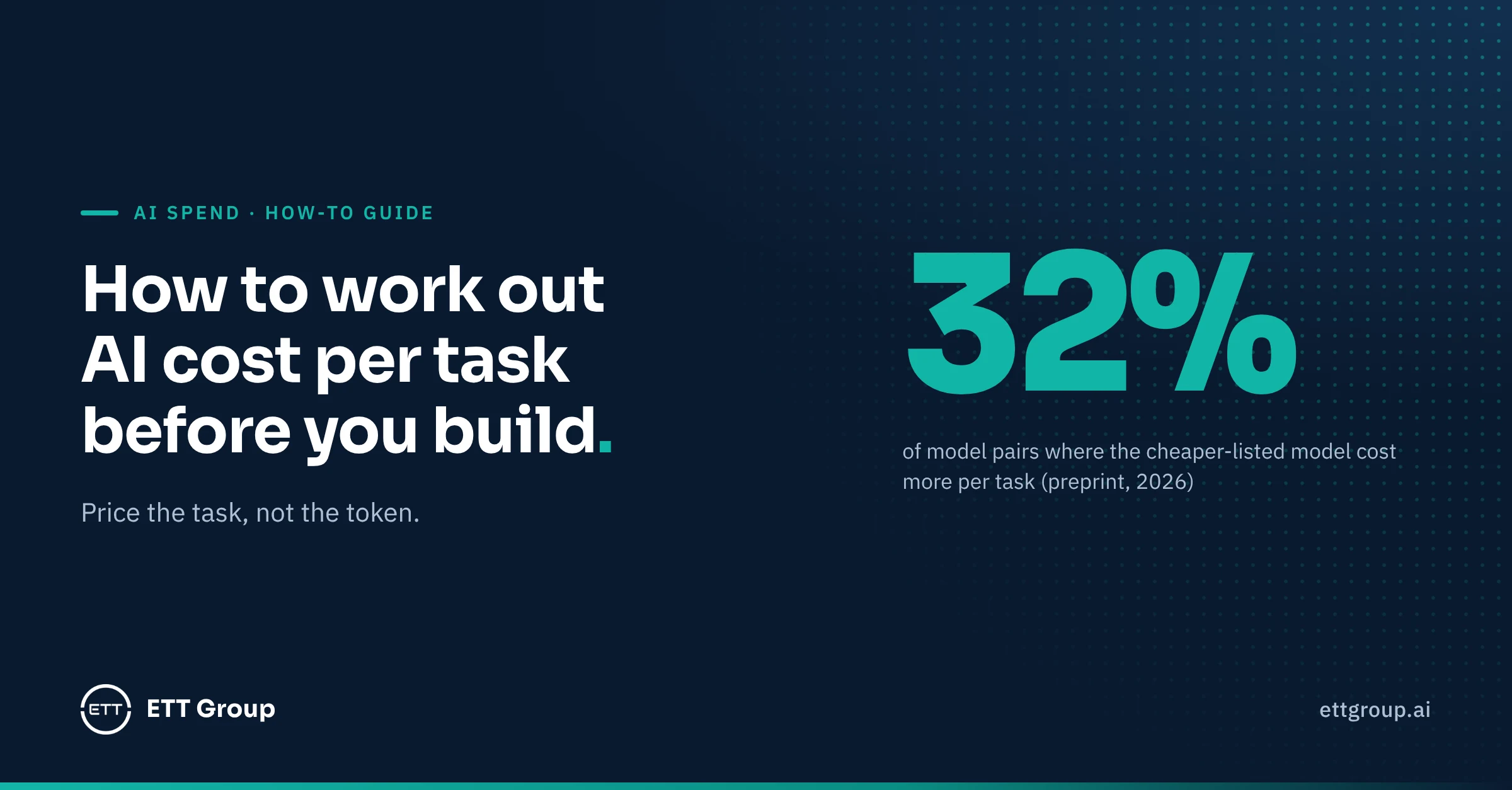
A preprint called "The Price Reversal Phenomenon" (March 2026, not yet peer reviewed) compared eight reasoning models across twelve tasks. In 32% of model pairs, the model with the cheaper list price cost more in total, by up to 28 times. Thinking tokens for the same query varied by up to 9.7 times from one run to the next.
Three things sit between a rate card and a bill:
- Tokenizers. Models split the same text into different numbers of tokens. Anthropic says the tokenizer on Claude 4.7 and later models produces about 30% more tokens for the same text, at unchanged per-token prices.
- Hidden reasoning. Reasoning models think before they answer, and the thinking is billed. Google's Gemini pricing states that output prices include thinking tokens.
- Loops. An agent rarely makes one call. It plans, calls a tool, reads the result, checks its work and sometimes starts again. Gartner has said production systems can be orders of magnitude more expensive than pilots (as reported by THE Journal).
In the State of FinOps 2026 survey, the second most requested tool was a way to cost an architecture before it is deployed. Cost per task is the core of that.
How do you work out AI cost per task?
Seven steps. You need a spreadsheet, a sample of real documents and the vendors' pricing pages.
- Define the task and the unit of work. A task is a finished outcome, not a prompt. "One supplier invoice matched to its purchase order and posted" is a task. "One call to the model" isn't. Choose a unit finance already counts, such as invoices a month or claims a week, so volume comes from a system rather than a guess. Decide what "finished" means, including tasks that end in a hand-off to a person. And check the task needs a model at all: some steps are cheaper and more predictable as rules (see When rules are enough, and when an AI agent adds value).
- Count the model calls per task. Walk through the task and list every call: classification, extraction, drafting, every tool call (the tool's result goes back to the model, which is another call), every turn of an agent loop, retries after time-outs or badly formed output, and every checking pass where a second model, or the same one, reviews the work. Record a low, typical and high count. For agents, the loop count is the figure most worth arguing about.
- Estimate input and output tokens per call. Input is everything you send: instructions, the document, retrieved context and, in a loop, the history so far, which grows every turn. Output is the visible answer plus any hidden reasoning, which is billed as output. Don't convert words to tokens with a rule of thumb. Run a sample of your own documents through each candidate model and read the token counts the API reports, because tokenizers differ between vendors and between model versions. Reasoning varies from run to run, so record a range.
- Price each call from the vendor rate card, then apply the multipliers. Take input, output and cached-input rates from the vendor's pricing page on the day, then adjust. Batch processing is about 50% off at Anthropic, OpenAI and Google, for work that can wait. Prompt caching only applies to the repeated part of the input, such as standing instructions; Anthropic says it can cut cost by up to 90% on long, repeated prompts, which is its own claim. Data residency costs more: OpenAI adds 10% on regional processing endpoints for models released on or after 5 March 2026, and Anthropic charges 1.1 times for US-only inference on Claude 4.6 and later. Last, look for dated price changes. Google's Gemini 3.6, 3.7 and 3.8 Flash prices double from 1 January 2027 (Standard tier input from $0.75 to $1.50, output from $3.75 to $7.50 per million tokens). If the system goes live next year, price it at next year's rates.
- Add the costs that aren't tokens. A Gartner research note in July 2026 said workflow design, rework and inconsistent execution often drive more cost than models and tokens. Put four more lines on the sheet. Checking: any second-model pass or guardrail, priced like any other call. Human review: the share of tasks a person checks, times minutes per check, times a loaded hourly cost. Rework: the share of tasks that fail and get redone, by the model or by a person. Platform units: UiPath, for example, charges agents that use UiPath-hosted models per LLM call, by model tier, and meters LLM-as-judge guardrails separately, so the call count from step 2 drives platform cost as well as token cost. Pay-i's chief executive, writing in McKinsey Quarterly, estimates that about 60% of an agentic task's cost is checking, repairing and re-verifying. Yours may differ, but it belongs in the number.
- Multiply by volume at half, expected and double. Cost per task times tasks a month gives a monthly run-rate. Do it three times. Before go-live, volume is the assumption you know least well: adoption runs faster or slower than planned, and peaks arrive. If the double-volume figure breaks the business case, find out now. Note anything that won't scale in a straight line, such as a review team that grows in whole people.
- Compare models on cost per task, not price per token. Run the same sample of real tasks through each shortlisted model and record calls, tokens, retries and how often the output needed fixing. Then price each one through steps 4 to 6. A model that is cheaper per token but needs more loops, more reasoning or more review can cost more per finished task, which is what the Price Reversal preprint found in 32% of pairs.
What does a worked example look like?
Everything below is illustrative, not a quote. The volumes, token counts, review times and hourly cost are invented round numbers, and the per-million-token prices are example rates: check the vendor page.
The task: one supplier invoice extracted, matched to its purchase order, checked and posted, with exceptions sent to a named person. Expected volume: 10,000 invoices a month.
Cost per task, one model (illustrative, not a quote)
| Line | Assumption | Cost per task |
|---|---|---|
| Model calls | 5 a task: classify, extract, match, one checking pass and one retry on average | Priced in the next two lines |
| Input tokens | 10,000 a call, 50,000 a task, at $2 per million (example rate, check the vendor page) | $0.10 |
| Output tokens, including reasoning | 2,000 a call, 10,000 a task, at $10 per million (example rate, check the vendor page) | $0.10 |
| Residency uplift | 10% of token cost | $0.02 |
| Platform units | 5 calls at $0.01 a call | $0.05 |
| Human review | 1 task in 10 checked, 3 minutes each, at $40 an hour | $0.20 |
| Rework | 2 tasks in 100 redone by a person, 15 minutes each, at $40 an hour | $0.20 |
| Total | $0.67 |
Tokens are $0.20 of the $0.67. In this example, the people around the model cost more than the model. If the work can wait and batch pricing applies, the token lines roughly halve. The review and rework lines don't move.
Same task, two models (illustrative, not a quote)
| Model A | Model B | |
|---|---|---|
| Example rate per million tokens, input and output (check the vendor page) | $1 and $5 | $2 and $10 |
| Calls per task | 8 | 5 |
| Input tokens per call | 10,000 | 10,000 |
| Output tokens per call, including reasoning | 6,000 | 2,000 |
| Token cost per task | $0.32 | $0.20 |
| Platform units at $0.01 a call | $0.08 | $0.05 |
Model A has half the list price and costs 60% more per task in tokens, before you count any extra review its output needs. That is the Price Reversal pattern in miniature.
Model B at three volumes (illustrative, not a quote)
| Volume | Invoices a month | Monthly cost | Annual cost |
|---|---|---|---|
| Half | 5,000 | $3,350 | $40,200 |
| Expected | 10,000 | $6,700 | $80,400 |
| Double | 20,000 | $13,400 | $160,800 |
That range, with the assumptions from the first table written beside it, is what goes into the forecast.
Checklist: is your cost-per-task figure ready to use?
- The task is a finished outcome, counted in a unit finance already tracks.
- Every call is listed, including tool calls, loop turns, retries and checking passes.
- Token counts come from your own documents, measured on each candidate model.
- Output includes reasoning tokens, recorded as a range.
- Batch, caching, residency and dated price changes are applied.
- Review, rework and platform units are on the sheet.
- Volume is shown at half, expected and double.
- Each assumption has an owner and the date it was priced.
How ETT can help
The AI Spend Forecast is a fixed-price, three-week service on ETT's Analect platform. It prices your workloads against about 200 models from 27 providers, filtered by your data residency and approved-vendor rules, sets seats against tokens with a break-even, and gives a monthly and annual run-rate per workload at half and double volume.
FAQ
Is a cheaper model always cheaper per task?
No. In the Price Reversal preprint, which tested reasoning models, the model with the cheaper list price cost more in total in 32% of pairs, by up to 28 times. Test your shortlist on your own tasks before you choose.
Why does the same task cost a different amount each time?
Reasoning models decide how much to think on each run, and the thinking is billed as output. The same preprint saw thinking tokens for one query vary by up to 9.7 times between runs. Agents add more variation, because loops and retries change with the input. Budget with a range, not a point.
Should human review count as part of AI cost per task?
Yes. If a person checks some outputs or fixes the ones that fail, that time is part of what the task costs. Leave it out and the AI looks cheaper than it is. When you compare with today's cost, be careful with released time: Time released is not cash saved explains why.
How often should I recalculate cost per task?
Whenever a vendor changes a price, a tokenizer or a model version, and at least once a quarter. Some changes are already scheduled, such as the Gemini Flash price rise on 1 January 2027. A figure priced in November can be wrong by January.
Sources
- Chen et al., "The Price Reversal Phenomenon: When Cheaper Reasoning Models Cost More", arXiv preprint 2603.23971, March 2026, revised May 2026, not peer reviewed: arxiv.org/abs/2603.23971
- Anthropic, Claude API pricing documentation (tokenizer note, US-only inference, batch), accessed 9 Oct 2026: platform.claude.com
- Anthropic, "Prompt caching" (vendor claim of up to 90% lower cost), 14 Aug 2025: claude.com
- OpenAI, API pricing documentation (regional processing uplift, batch), accessed 9 Oct 2026: developers.openai.com
- Google, Gemini API pricing (thinking tokens in output, 1 Jan 2027 Flash prices, batch), accessed 9 Oct 2026: ai.google.dev
- UiPath, Agents licensing documentation, accessed 9 Oct 2026: docs.uipath.com
- THE Journal, reporting Gartner research on generative AI budgets, 22 Jun 2026: thejournal.com
- Gartner, "5 Misconceptions Driving GenAI Cost Overruns" (research note abstract), 13 Jul 2026: gartner.com
- FinOps Foundation, State of FinOps 2026: data.finops.org
- McKinsey Quarterly, David Tepper (Pay-i), on cost versus value in agentic AI, 8 Jul 2026: mckinsey.com