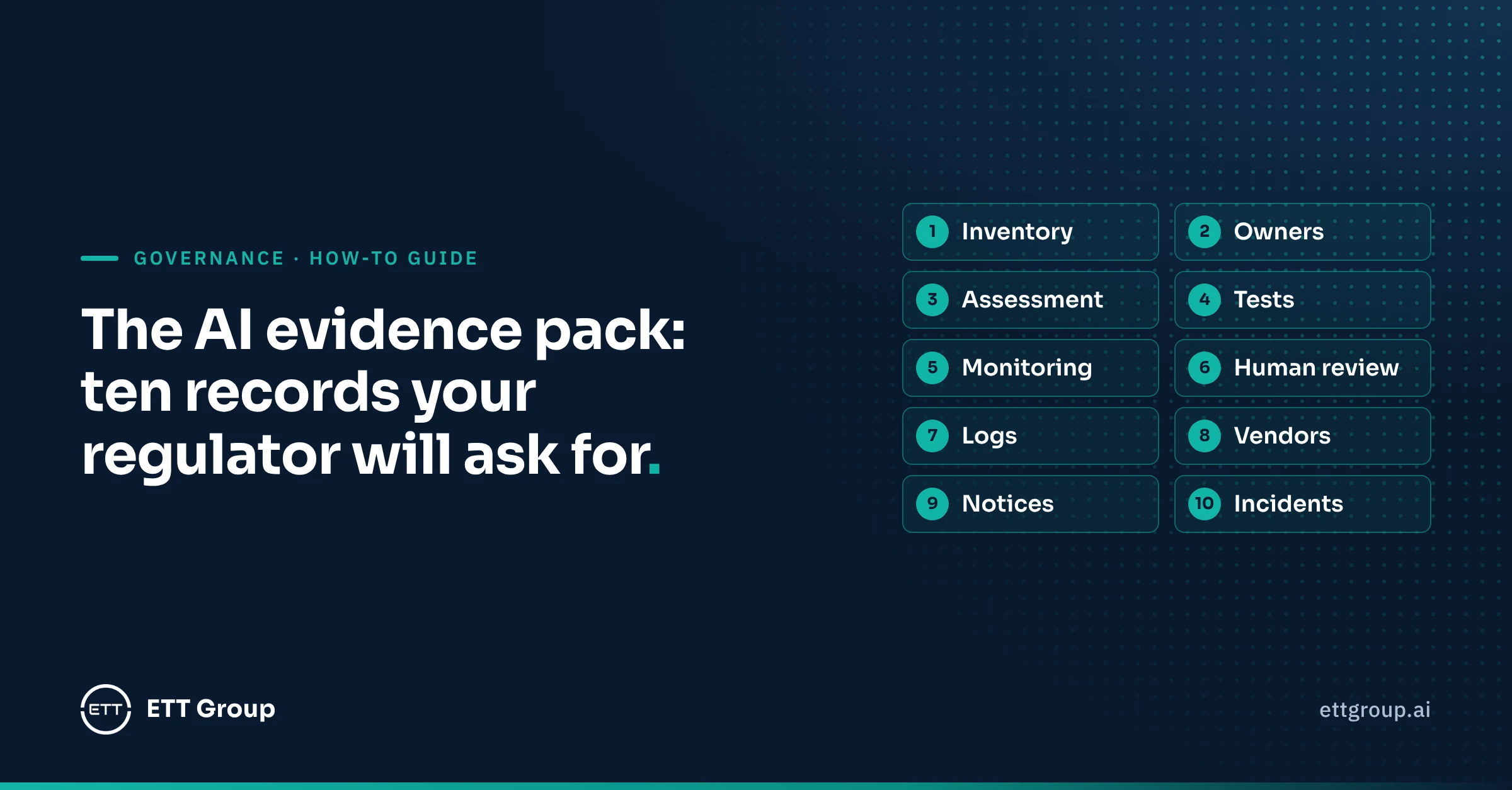
What evidence do auditors and regulators need for AI? Ten records, who asks for each, what good looks like, and where firms usually fall short.
Auditors and regulators ask for ten records: an AI inventory with risk ratings, named owners, a risk assessment before use, tests against thresholds set in advance, monitoring records, proof of human intervention, decision logs, vendor due diligence, notices and appeal records, and an incident log.
No regulator publishes this list in one place. Read the EU AI Act, OSFI E-23, the NAIC bulletin, US supervisors, UK data protection law and the new US state laws side by side, and the same ten records keep appearing. Build the pack once and you can answer most requests from it.
What are the ten records, and who asks for each?
| Record | Who asks | What good looks like |
|---|---|---|
| 1. Inventory with risk rating | OSFI E-23, NAIC bulletin, PRA SS1/23 | Every system, built or bought, rated, with a review date |
| 2. Named owners | NAIC bulletin, FCA (SM&CR), EU AI Act Art. 26, SEC | A person, not a team, linked to a senior manager |
| 3. Risk assessment before use | EU AI Act Art. 9, ICO draft guidance, California CCPA | Signed off before go-live, updated on change |
| 4. Tests against preset thresholds | EU AI Act Art. 9 and 15, OSFI E-23, NAIC, SEC | Pass mark written down first, checked independently |
| 5. Monitoring and drift | OSFI E-23, NAIC bulletin, EU AI Act Art. 26 | A fixed cadence, a trend, action on breaches |
| 6. Human intervention | EU AI Act Art. 14 and 26, UK GDPR Art. 22C, Colorado, California, FINRA, insurers | Trained reviewers, overrides on record |
| 7. Decision logs | EU AI Act Art. 12 and 26, FINRA, Colorado | Any decision rebuilt in an hour, without an engineer |
| 8. Vendor due diligence | OSFI E-23, NAIC bulletin, PRA SS1/23, FINRA | A file per vendor model, plus your own checks |
| 9. Notices and appeals | Colorado, California, UK GDPR Art. 22C, EU AI Act Art. 26 and 50, NAIC | Templates in use, every request logged |
| 10. Incident log | EU AI Act Art. 26, internal audit | Near misses too, each tied to a fix |
On dates: the EU AI Act's high-risk duties (Articles 9 to 15 and 26) apply to Annex III uses from 2 December 2027, while Article 50 already applies. Colorado and California start on 1 January 2027, OSFI E-23 on 1 May 2027.
1. An inventory with a risk rating
Every AI system, model and agent you run, built or bought, with a risk rating that sets how closely it's watched.
Who asks: OSFI E-23, vendor models included. The NAIC AI bulletin, adopted in 26 US jurisdictions. PRA SS1/23, for UK banks with internal model approval.
Good: One inventory across the business, with an owner and a next review date on every line.
Common gap: AI bought by business units. If procurement can find it and the inventory can't, the inventory is wrong.
2. Named owners and senior accountability
A named person accountable for each system, with a clear line to the senior manager who answers for it.
Who asks: The NAIC bulletin (senior management accountability). The FCA, through the Senior Managers and Certification Regime rather than AI-specific rules. EU AI Act Article 26 (competent people assigned to oversight). SEC examiners (policies and procedures to supervise AI use).
Good: Owners who know they're owners, and AI risk reaching a senior committee.
Common gap: "IT" or "the vendor" in the owner column.
3. A risk or impact assessment before use
A dated assessment of what could go wrong, for whom, and which controls you put in place.
Who asks: EU AI Act Article 9 for high-risk providers. The ICO's draft guidance on automated decisions (a DPIA is likely to be needed). California's CCPA rules (risk assessments for new processing). Colorado is the exception: SB 26-189 dropped impact assessments in favour of notices and human review.
Good: Completed before go-live and updated whenever the model, data or scope changes.
Common gap: An assessment written once for the pilot and never revisited for production.
4. Test results against thresholds set in advance
Evidence the system was tested, accuracy included, against a metric and pass mark written down beforehand.
Who asks: EU AI Act Article 9 (testing against "prior defined metrics and probabilistic thresholds") and Article 15 (accuracy metrics declared in the instructions for use). OSFI E-23 (review independent of development, defined thresholds for breaches). The NAIC bulletin (validation). SEC examiners (whether what you say about your AI is accurate).
Good: The metric, threshold, test set and result, checked by someone other than the builder. For generated text, a claim-by-claim check against sources, as in our Accuracy Evidence File.
Common gap: A vendor's benchmark filed as if it were your own test.
5. Monitoring and drift records
Proof you kept checking after go-live, and acted when results moved.
Who asks: OSFI E-23 (monitoring scaled to the risk rating). The NAIC bulletin (drift monitoring). EU AI Act Article 26 (deployers monitor, and suspend use if a risk appears).
Good: A fixed cadence, a trend over time, and what you did about each breach.
Common gap: Monitoring that tracks uptime and cost but not whether the outputs are still right.
6. Proof a competent human could and did intervene
Records showing reviewers understood the system, had authority to change the outcome, and sometimes did.
Who asks: EU AI Act Article 14 (the ability to override or stop) and Article 26 (competent overseers). UK GDPR Article 22C safeguards (since 5 February 2026), with the ICO's draft guidance saying human involvement must be active, not tokenistic. Colorado's right to meaningful human review and California's human appeal route. FINRA (human monitoring of outputs). Insurers, who increasingly want evidence of human oversight.
Good: Training records for reviewers, and a log of overrides as well as approvals.
Common gap: Reviewers who have never overturned anything. A regulator will ask whether they were reviewing at all.
7. Logs that rebuild any decision
Enough detail to reconstruct a single decision: the inputs, what the system did, the output and who approved it.
Who asks: EU AI Act Article 12 (automatic logging) and Article 26 (deployers keep logs for at least six months). FINRA (tracking agent actions). Colorado SB 26-189 (three years of records).
Good: Someone in risk can rebuild a decision without an engineer. For agents, the log shows what the approver saw next to what ran (see our agent governance framework).
Common gap: Logs that exist but can't be tied to a policy, a person or a customer.
8. Vendor due diligence
A file for every third-party model or AI service you rely on.
Who asks: OSFI E-23 (vendor models are the institution's model risk). The NAIC bulletin (third-party due diligence). PRA SS1/23 (vendor models in scope). FINRA (due diligence on generative AI vendors).
Good: What the model does, how the vendor tested it, what data it uses, how you'll hear about changes, and your own checks on its results.
Common gap: A security questionnaire filed as if it covered model risk.
9. Notices, explanations and appeal records
What you told affected people, what they asked for, and what happened next.
Who asks: Colorado SB 26-189 (explain the AI's role in an adverse decision within 30 days, a right to correct data, meaningful human review). California's ADMT rules (pre-use notice, opt-out or human appeal, access to the logic and outcome). UK GDPR Article 22C. EU AI Act Article 26 (inform affected people) and Article 50 (tell people they're dealing with AI). The NAIC bulletin (consumer notice).
Good: Approved templates, and a log of every request with dates and outcomes.
Common gap: A notice drafted by legal that operations can't fulfil inside the deadline.
10. An incident log
Every AI error that reached a customer, a record or a decision, with cause, impact and fix.
Who asks: EU AI Act Article 26 (deployers report serious incidents, which means knowing you've had one). Internal audit, every time.
Good: Near misses logged as well as incidents, each linked to a change in tests or controls.
Common gap: Errors fixed quietly in the workflow and never written down.
Is there an accuracy threshold you have to meet?
No. None of the regimes above sets a numeric accuracy threshold for AI output. What they ask for is a metric you stated, a check independent of whoever built the system, a threshold set before testing, and a named human who acts when it's breached. That's records 4 and 6 working together. A score on its own doesn't meet that bar; see An accuracy score is not evidence.
Where do US banks stand after SR 26-2?
SR 26-2 (Federal Reserve, OCC and FDIC, 17 April 2026) replaced SR 11-7 and is aimed mainly at banks over $30bn in assets. Its attachment says generative and agentic AI are not within its scope, leaving them to each bank's own risk management. That doesn't remove the need for these records. It means the bank has to set its own standard, write it down and show it followed it.
Where does ISO/IEC 42001 fit?
ISO/IEC 42001 is a management-system standard for AI. Mapping your evidence pack to its clauses helps show the system is run consistently. Two limits: it isn't a harmonised standard under the EU AI Act, and it describes how you manage AI, not whether any given output was right. More in ISO 42001 and the EU AI Act.
How do you build the pack?
- Start with the inventory. Include agents and vendor tools. Everything else hangs off it.
- Rate and name. A risk rating and a named owner on every line. Highest-rated systems first.
- File what you already have. Assessments, test results and vendor files usually exist somewhere. File them against the inventory line.
- Fix the logs. Rebuild one decision for each high-rated system. Set retention to the longest rule that applies.
- Set the cadence. Monitoring, review sampling and incident review on a fixed schedule, at least monthly for high-rated systems.
- Run a mock request. Ask someone outside the team to request the pack for one system and one decision. Time it, then fix whatever slowed them down.
How ETT can help
For UiPath estates we run under Agentic Managed Services, the monthly evidence report covers drift checks, change control and a sample of agent-written outputs checked against their sources. That keeps the monitoring record current, rather than rebuilt the week before an audit. See Agentic Managed Services.
FAQ
What is an AI audit framework?
It's the structure an auditor uses to test how you govern AI. For internal audit, the IIA's AI Auditing Framework (updated in 2024) is the obvious starting point. Whatever framework is used, the testing comes back to records like the ten above. No records, nothing to test.
How long should we keep AI decision logs?
It depends on the rule. Under the EU AI Act, deployers of high-risk systems must keep logs for at least six months, from 2 December 2027 for Annex III uses. Colorado SB 26-189 requires three years of records from 1 January 2027. Set retention to the longest rule that applies.
Who should own the evidence pack?
The teams running the systems produce the records. Risk or compliance should own the pack and the standard it's held to. Internal audit tests it. If one team builds, owns and tests the pack, it isn't independent.
Sources
- artificialintelligenceact.eu, Article 9 Risk management system, Article 12 Record-keeping, Article 14 Human oversight, Article 15 Accuracy, Article 26 Obligations of deployers and Article 50 Transparency
- artificialintelligenceact.eu, Implementation timeline (after the Digital Omnibus)
- National Law Review (K&L Gates), EU Digital Omnibus on AI enters into force, 31 Jul 2026
- OSFI, Guideline E-23 Model Risk Management (2027), issued 11 Sep 2025
- NAIC, AI model bulletin adoption map, status at 31 Aug 2026
- Federal Reserve, SR 26-2, 17 Apr 2026 and SR 26-2 attachment
- Bank of England, PRA SS1/23 Model risk management principles for banks, current version 23 Apr 2026
- FCA, FCA announces second cohort of AI Live Testing, 21 Apr 2026
- legislation.gov.uk, SI 2026/82 (UK GDPR Articles 22A to 22D in force 5 Feb 2026)
- ICO, consultation on draft guidance on automated decision-making, 31 Mar to 29 May 2026
- Covington Inside Privacy, UK ICO consults on draft automated decision-making guidance, 24 Apr 2026
- Eckert Seamans, Colorado repeals and replaces its landmark AI statute, 12 Jun 2026
- Manatt, California finalizes rules on automated decisionmaking, risk assessments and cybersecurity audits, 25 Sep 2025
- Sidley Data Matters, FINRA issues 2026 regulatory oversight report, 16 Dec 2025
- Foley, SEC releases its 2026 examination priorities, 17 Dec 2025
- Insurance Journal, generative AI exclusions and insurer expectations, 17 Aug 2026
- IIA, The IIA's updated AI Auditing Framework, 2024 update