Process mining, task mining, process intelligence and discovery workshops compared: what each tells you, what it needs, and which to start with.
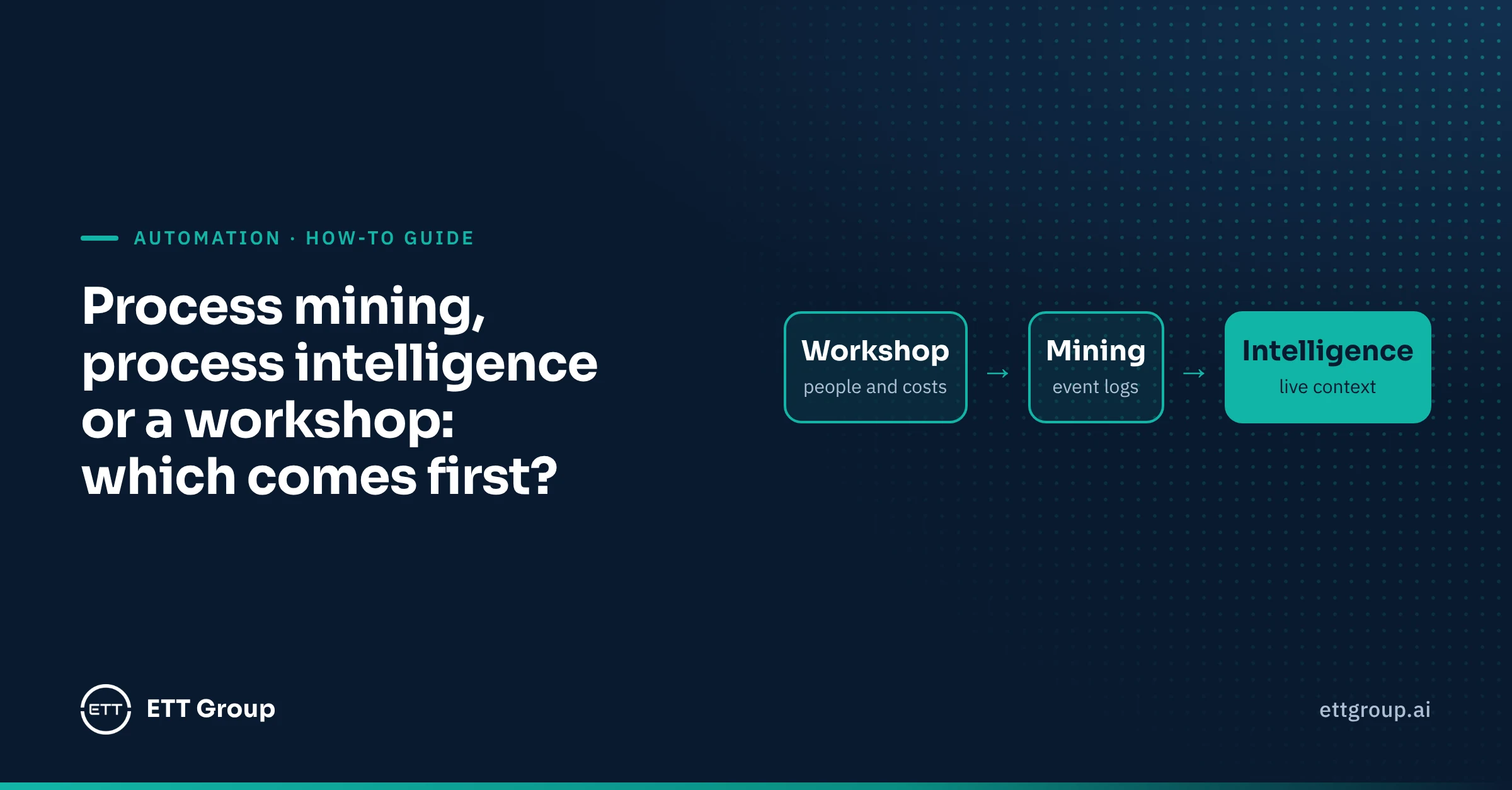
Process mining shows how work has actually flowed through your systems, process intelligence adds live and predictive context so automation and AI agents can act on it, and a discovery workshop tells you which processes are worth either: if you don't yet know which processes matter, the workshop comes first.
The terms get used as if they meant the same thing, and Gartner renaming its process mining category in May 2026 has made that worse. They answer different questions, at different stages, from different inputs. This guide defines each one plainly, compares them side by side, and sets out the order I'd use them in before automating anything.
What is process mining?
Process mining reconstructs how work actually flows by reading the event logs your systems already keep. Every time an order is created, approved, changed, sent back or invoiced, the ERP, CRM or claims system records what happened and when. Mining stitches those records together into a picture of every route the work took.
To do that, the data needs three things: a case identifier (the order or claim number), an activity, and a timestamp. Older systems sometimes need work to get them out.
What comes back is usually uncomfortable. There's rarely one process. There's a main path and a long tail of variations nobody designed. Much of the elapsed time sits in waiting between steps rather than in the steps. And there are loops: work sent back, rejected, corrected and resubmitted.
Two limits matter. Mining is historical: it tells you what happened over the period you extracted, not what is happening now. And it only sees what systems record. Work done in email, spreadsheets and conversations is invisible to it.
What is task mining?
Task mining works one level down. It records activity on people's desktops (applications opened, screens used, copy and paste between systems) to show how an individual task is really done.
It fills the gap mining leaves. If the event log shows a case sitting with one team for most of a day, task mining can show what was happening: rekeying from a PDF, checking a spreadsheet, looking something up in a second system.
It needs a recorder on the desktops you're studying, the agreement of the people being recorded, and clear rules about what gets captured. It sees tasks, not the end-to-end case, so it works best alongside process mining, aimed at the steps where the logs go quiet.
Process mining vs process intelligence: what's the difference?
Process intelligence is the name Gartner now uses for the whole category. On 5 May 2026 it replaced its Magic Quadrant for process mining platforms with one for process intelligence. The plain difference is this: process mining analyses historical event records, while process intelligence adds real-time and predictive context for AI and automation.
In practice that means a continuous connection to your systems rather than a one-off extract, and a model of the process that software can draw on while work is in flight. It earns its keep when many automations or agents depend on the same live picture of how the business runs.
Vendors are pushing the idea hard. Celonis's own 2026 survey of 1,649 business leaders (vendor data, from a company that sells process intelligence) found 76% say their current processes are holding them back, and 82% think AI will fail to deliver a return if it doesn't understand how the business runs. Read that as a signal of where buyers' heads are, not as proof.
What is a discovery workshop?
A discovery workshop starts with people, not data. Interviews with the people who do the work, time spent watching them do it, and a costing of what the process consumes in effort, errors, rework and delay. It ends with decisions: which processes are worth changing, how, and in what order.
It needs no system access. In a regulated firm, approval to extract event logs from a core system can take a while, and you shouldn't wait for it to find out which process deserves the effort.
A workshop finds what no log records: the spreadsheet that holds the process together, the approval that happens in a corridor, the exception one person handles from memory. Its weakness is precision. Interviews tell you what people believe the volumes and delays are. Mining tells you what they are.
How do they compare?
| Approach | What it tells you | What it needs | Typical time | Best when | Limits |
|---|---|---|---|---|---|
| Discovery workshop | Which processes matter, how they really run (including work off-system), what they cost, who owns each decision | People's time for interviews, observation and costing. No system access or licences | 4 to 6 weeks for our fixed-scope version | You don't know where to start, or your logs are thin | Volumes and delays are estimates, not measurements |
| Process mining | Every route work took through your systems, how often, how long each step waited, where it looped | Event logs with a case ID, activity and timestamp; approval to extract them; a mining tool | About 12 weeks across 3 processes in a typical discovery of ours | The process runs through systems with logs and volumes are high | Historical only; blind to email, spreadsheets and conversations |
| Task mining | How individual tasks are done on the desktop: rekeying, lookups, switching between applications | A desktop recorder, consent from the people recorded, clear capture rules | Usually run inside a mining discovery, on chosen steps | You need to see the work between systems | Sees tasks, not the whole case; privacy handling takes care |
| Process intelligence | What is happening now and what is likely to happen next, as context for automation and agents | A continuous connection to source systems, a maintained process model, people to run it | Ongoing: a platform you operate | Agents are about to run at scale and need live context | Wasted if you don't yet know which processes matter |
Which should come first? A step-by-step decision guide
- Ask whether you know which processes matter. If the honest answer is no, or the shortlist is whatever the loudest department wants, start with a discovery workshop. Mining a process nobody should automate gives you precise data about the wrong thing.
- Check the logs before you plan any mining. For each shortlisted process, find out whether its systems record a case identifier, an activity and a timestamp, and who must approve the extract. If the logs are thin, or most of the work happens in email and spreadsheets, a workshop will tell you more, sooner.
- Mine the processes that run through systems and carry volume. Where there are logs and enough volume for variation to matter, process mining gives you the baseline you'll need later to prove a change worked. Keep the first batch small. Three processes is plenty.
- Add task mining where the logs go quiet. If mining shows work waiting with one team and nobody can explain why, record the desktop work on those steps.
- Decide what each step should become. Put four questions to every step: could a rule do this, does it need AI to read a document, does it need an agent's judgment, or should it be fixed first or left alone? Use rules where rules work, and put an agent only where the judgment is. We've covered that choice in When a rules-based workflow is enough, and when an AI agent adds value.
- Move to process intelligence when agents are about to run at scale. Once several agents or automations depend on the same process and need to know what is happening now, live context is worth paying for. Before that, a well-kept process map and a periodic re-mine usually do the job.
Why does the order matter?
Because every probabilistic step you add on top of a process you don't understand multiplies the error. At UiPath FUSION in September, SMBC used a worked example: three steps at 90% accuracy each come out at about 73% end to end, which it called not acceptable for accounting. Fewer steps, properly understood, beat more steps automated cleverly.
The survey evidence points the same way. McKinsey's State of AI 2026 found nearly three-quarters of AI high performers had fundamentally redesigned their workflows, against about a quarter of other respondents. That's a correlation, not a controlled study. Deloitte's Tech Trends 2026 makes the same argument from the other side: don't layer agents onto existing workflows; compare how work should run with how it runs today.
Where does UiPath's Map of Work fit?
UiPath's Cartographer and Map of Work, launched at FUSION in September 2026, are the newest version of an old idea: write the manual before you automate. Daniel Dines argued in his keynote that an LLM needs a manual of how the company works, and that no company has one.
Cartographer builds that manual from the same inputs this guide covers: process-mining diagrams, SOPs, interviews with subject experts and screen recordings. Each Map of Work has a named owner who approves every change, and a Decision Ledger records decisions and the reasons for them.
Two things follow. It doesn't replace discovery. It needs discovery's outputs, and Dines said himself that the first map is inevitably incomplete. And the named owner is the part worth copying whatever tool you use. A process map that nobody owns goes stale quickly, and an agent working from a stale map is guessing.
How ETT can help
We run a fixed-price Business Process Workshop (4 to 6 weeks, four lenses, no system access or licences needed) and process mining discovery on UiPath Process Mining, which typically runs about 12 weeks across 3 processes. If you already know which process matters and it has usable event logs, start with Process Mining and Discovery.
FAQ
Is process intelligence just process mining with a new name?
Partly. The core is the same: reconstructing a process from system data. What's added is real-time and predictive context, so automations and agents can use a live picture rather than a historical report. If you aren't running automation at scale yet, the difference may not matter to you.
Can we start with process mining and skip the workshop?
Yes, if you already know which process matters and its systems keep usable event logs. Mining will give you the variants and the baseline quickly. It won't show you the work done off-system or tell you whether you picked the right process, so pair it with time spent alongside the people who do the job.
Does task mining raise privacy concerns?
It records activity on people's desktops, so treat it like any other workplace monitoring. Tell people what is captured and why, limit capture to the applications and steps in scope, and agree retention with your data protection lead before you start.
Sources
- Gartner's renaming of the Process Mining Magic Quadrant to Process Intelligence (5 May 2026) and the mining vs intelligence distinction: IT Brief UK, 11 May 2026
- Celonis 2026 Process Optimization Report, vendor survey, n=1,649 (76% and 82%): Celonis, 2026 and IT Brief Australia, 14 Apr 2026
- UiPath Cartographer and Map of Work (sources, named owner, Decision Ledger): UiPath press release via Zawya, 1 Oct 2026
- Daniel Dines's keynote ("manual" argument, first map inevitably incomplete) and SMBC's worked example (about 73%): The Next Web, 23 Sep 2026
- High performers and workflow redesign, n=1,719: McKinsey, The state of AI 2026, 25 Aug 2026
- Don't layer agents onto existing workflows; compare how work should run with how it runs: Deloitte, Tech Trends 2026, 10 Dec 2025
- Workshop and discovery facts: ETT Group, Business Process Workshop and ETT Group, Process Mining and Discovery