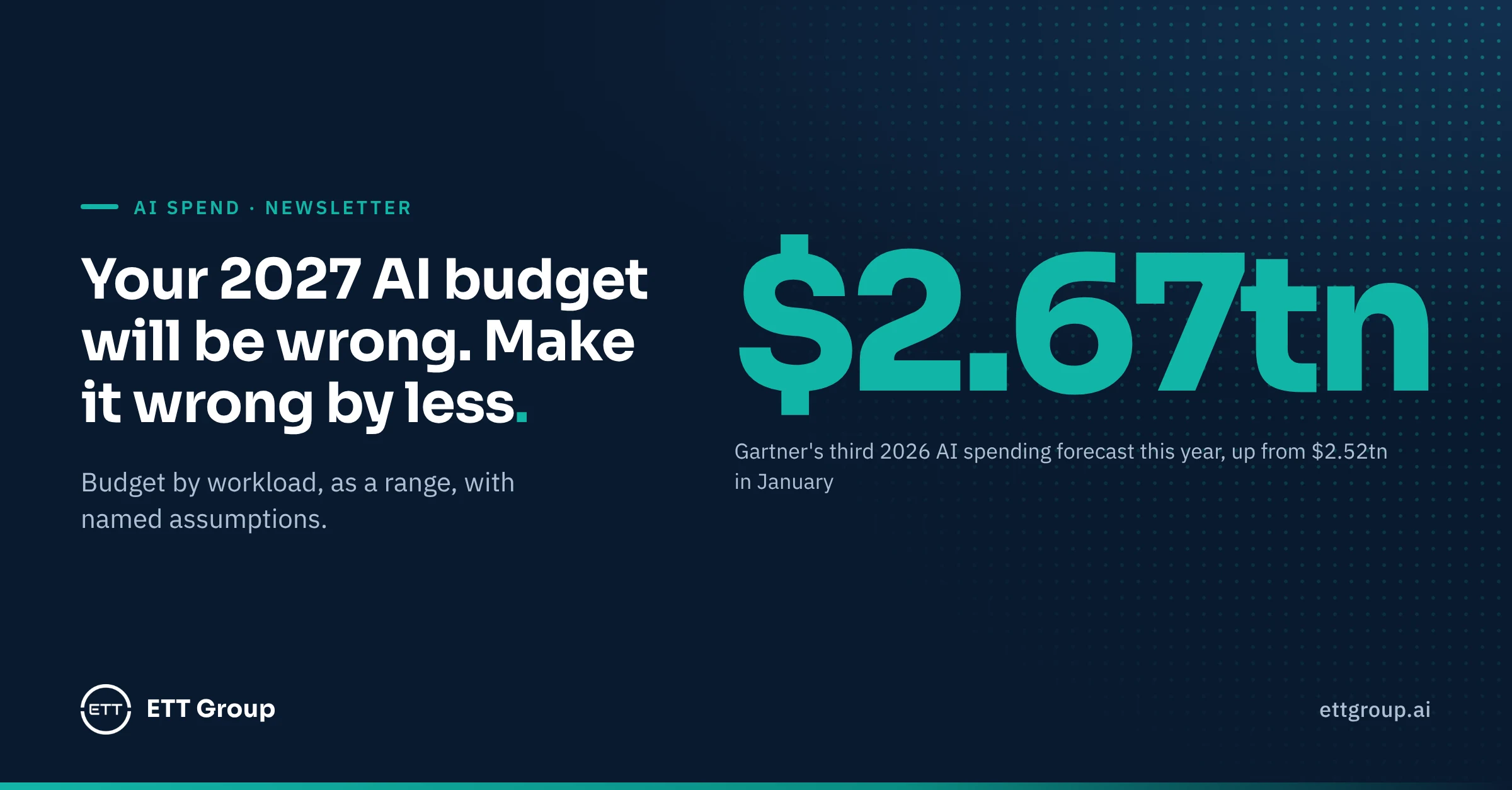
Gartner has published three different 2026 AI spend forecasts this year. Here's how to set a 2027 AI budget your finance team can defend.
Finance teams are setting FY2027 budgets now. Somewhere in most of those spreadsheets is a line called AI. In most cases it's one number, and that number will be wrong.
I don't say that to be clever. Every AI budget will be wrong. What matters is by how much, and whether you can say why when it happens.
Even Gartner can't hold its number
Gartner forecasts technology spending for a living, with more data than any finance team will ever have. In January it put worldwide AI spending for 2026 at $2.52 trillion. In May it raised that to $2.59 trillion. In September it raised it again, to $2.67 trillion.
Three numbers for the same year, from the same firm, between January and September.
If Gartner has to move its number every few months, a budget built from one pilot and a vendor quote isn't going to be right first time. Pretending otherwise is how you end up explaining an overspend next summer.
Budgets are rising faster than confidence
In April, Bain published a survey of more than 100 CFOs. 83% plan to raise AI spend by more than 15% over the next two years. Only 31% are satisfied with the outcomes they're getting.
KPMG asked leaders at large US companies how well they can see what their AI costs to run. Only 26% have full, real-time visibility. Only 36% have token or usage controls in place.
Put those side by side. A lot of the money being committed for 2027 is being committed by organisations that can't yet see what this year's money is doing. That's a budgeting problem, and it belongs to finance as much as to IT.
List price no longer predicts the bill
The old way to budget software was simple. Count the users, multiply by the licence price, add a bit for growth. I sold and delivered technology in the UK channel for about 20 years, and most software budgets I saw were built that way. It worked because the price list told you the bill.
With AI it doesn't. Three things now sit between the rate card and the invoice.
Tokenizers. The same text doesn't come out as the same number of tokens on every model. Anthropic says the tokenizer on Claude 4.7 and later produces about 30% more tokens for the same text, at unchanged per-token prices. Same document, same rate card, bigger bill.
Hidden reasoning. Reasoning models think before they answer, and you pay for the thinking. Google's Gemini pricing says its output prices include thinking tokens. A preprint published in March tested eight reasoning models. In 32% of model pairs, the model with the cheaper list price cost more in total, by up to 28 times. Thinking tokens for the same query varied by up to 9.7 times between runs.
Agent loops. An agent doesn't make one call. It plans, calls a tool, reads the result, checks its work and sometimes starts again. Every turn is another call. Gartner has said production systems can be orders of magnitude more expensive than pilots, and that at least half of generative AI initiatives will exceed their planned budgets through 2028 (both as reported by THE Journal).
Then the rates themselves move. Google has already published that some Gemini Flash prices double on 1 January 2027. If your 2027 budget priced a workload on one of those models at today's rate, it's out of date before the year starts.
What an honest AI budget looks like
So stop trying to get the number exactly right. Build one that's honest about how wrong it could be, and that tells you why when it moves.
In practice that means five things.
- A range by workload, not one line called AI. Invoice matching, claims summaries, the contact centre agent, the Copilot estate. Price each one separately, because each one behaves differently.
- Half and double volume. Before go-live, volume is the assumption you know least well. Price every workload at half, expected and double. If double breaks the case, you want to find out now, not halfway through next year.
- Named assumptions. Calls per task, tokens per call, which model, the residency rule, how many outputs a person reviews. Write them beside the number, so when actuals drift you can see which assumption broke.
- An owner in finance. Not only IT, and never the vendor. Someone who signs the number and answers for it every quarter.
- A quarterly re-forecast. Vendors change prices, tokenizers and models during the year. A budget set this autumn and left alone is stale by spring.
We put it this way at ETT: prices are facts, capability is an opinion, volumes are yours. You can look the prices up. Whether a model is good enough for the job is a judgement you have to test. Volume belongs to you, which is exactly why it gets a range and not a point.
Start with cost per task
The building block for all of this is cost per task. That means what one finished piece of work costs: every model call, the reasoning, the retries, the checking, and the person who reviews the exceptions. Price per token is an input. Cost per task is the number you can budget.
I've written up the method step by step, with a worked example: How to work out AI cost per task before you build. You need a spreadsheet and a sample of real documents. You don't need to have built anything yet.
The uncomfortable bit
A range looks less certain than a single number, and some boards won't like it. I'd push back. A single number isn't more certain. It just hides the uncertainty until the invoices arrive.
The finance teams that will be comfortable at the end of 2027 won't be the ones whose forecast was right. They'll be the ones who could say, every quarter, which assumption moved and what they did about it.
If you're setting a 2027 AI budget right now, is it one number or a range, and who in finance owns it?
Sources
- Gartner, 15 Jan 2026
- Gartner, 19 May 2026
- Gartner, 16 Sep 2026
- Bain, 13 Apr 2026
- KPMG AI Pulse Q2 2026
- Anthropic pricing
- Gemini API pricing
- The Price Reversal Phenomenon, arXiv preprint
- THE Journal reporting Gartner, 22 Jun 2026